The short version
Two things happen, on two timescales, through two different mechanisms. A single exposure changes how the neutrophil's beta-2 integrin grips a vessel wall, cutting adhesion by about half within two hours without changing how much receptor is present, and that reverses within a day.
A course of fifteen sessions does something else: in the one human study with a comparison group, beta-2 integrin expression fell 68%, adhesion function fell by around two thirds, and circulating TNF-alpha and IL-1beta dropped from the twelfth session and were still lower a month later. Meanwhile oxygen-dependent bacterial killing improves, which is why hyperbaric oxygen sits inside treatment protocols for necrotizing infection. That combination is selectivity rather than suppression.
Sixty-eight percent of one receptor, and a second one deactivated rather than removed
The most informative human study on this question came out of the University of Bologna and a hyperbaric center in Ravenna in 2020. Monica Baiula's group took blood from 15 patients with chronic non-healing wounds who were partway through a course of hyperbaric oxygen, and from 15 comparison patients receiving standard wound care alone. They sampled before treatment, then immediately after the 4th, 8th, 12th and 15th sessions, and again one month after the last one.
Two adhesion receptors were measured: beta-2 integrin, which neutrophils use to grip the vessel wall before crossing into tissue, and alpha-4 integrin, which does a related job. Beta-2 expression fell by 68% and was still reduced a month after the last treatment, while alpha-4 levels did not change. Neither moved in the control group.
Read only that far and you would conclude the treatment picks one receptor and ignores the other. The adhesion data says something more precise. Function fell for both, by 67% for beta-2 and 70% for alpha-4, and the authors traced the alpha-4 result to a conformational change: the receptor was still there in the same numbers, but sitting in its low-affinity shape. So a course does not switch off a list of receptors. It reduces the ability of neutrophils to stick, by removing one receptor and deactivating another.
This is also the point at which to correct the paper's own record, because it matters if you are comparing protocols. The abstract gives the treatment pressure as 150 kPa, roughly 1.5 ATA. The methods and results sections both specify 245 kPa, about 2.4 ATA, delivered as 100% oxygen by mask in 20-minute cycles separated by 3-minute air breaks, in a multiplace chamber. The higher figure is the one to use.
Limitations of this study
- Fifteen patients per arm. The sample size was calculated in advance, but allocation followed each patient's prescribed care rather than randomization, and the comparison group was not sham-treated.
- Patients were a median 76 years old with chronic non-healing wounds, a population with active local inflammation and impaired perfusion. The findings may not transfer to healthy tissue.
- Anyone taking steroids, NSAIDs or antibiotics was excluded. That removes an obvious confounder from the cytokine result and narrows who the result applies to.
- The receptor and cytokine outcomes are surrogates, measured on neutrophils drawn from blood rather than taken from the wound. The two populations need not behave identically.
- Single center, unblinded assessment of wound score.
The same study reported wound closure, not only markers
Worth stating plainly, because it is the part most summaries drop: wound area in the treated group fell by about 60% across the 15 sessions and by about 80% by one month afterwards, with four of the fifteen ulcers fully healed. The control group showed a small, non-significant improvement. Those are the clinical numbers behind the marker numbers, from an unblinded study of fifteen patients, and they sit alongside the European consensus, which suggests hyperbaric oxygen for diabetic foot lesions and ischemic ulcers rather than strongly recommending it.
Circulating cytokines needed twelve sessions to move
The cytokine data in the same study has a shape worth holding onto. TNF-alpha and IL-1beta fell at the level of neutrophil messenger RNA soon after the fourth session. Circulating levels of both proteins took longer: nothing measurable at session 4 or 8, a significant drop from session 12, still lower a month after the last treatment. Neither marker moved at any point in the control group.
If you want to know what a course does that a session cannot, that is the most direct answer in the human literature. It also matches the dose logic written into accepted hyperbaric indications, where the European consensus expects at least 11 to 12 weeks and roughly 60 sessions before any significant clinical effect in refractory chronic osteomyelitis. Courses are planned as courses for a reason, and ours are too.
One session changes how the receptor works, and it wears off by the next day
Run the same question on a single exposure and you get a different answer, which is why the two should not be pooled.
Stephen Thom's group at the University of Pennsylvania had healthy subjects breathe oxygen at up to 3.0 ATA for 45 minutes and measured neutrophil binding. Exposure at 2.8 or 3.0 ATA inhibited beta-2 integrin-dependent adherence with no effect on how much beta-2 integrin sat on the cell surface. The receptor was all still there. It had stopped gripping properly, through a route the authors linked to impaired cGMP synthesis.
A separate volunteer study put numbers on the duration. After a single exposure at 3.0 ATA, adhesion fell about 50% at two hours and had returned to pre-treatment levels by six hours. Neutrophil clumping under flow, which depends on the same receptor, fell from 20% of cells to 3.4% at two hours. A large effect, and a short one.
That study also found something the tidy version of this story leaves out: adhesion to endothelial cells that had been stimulated with IL-1beta was not inhibited. Take the two results together and the effect looks narrower than "hyperbaric oxygen stops neutrophils sticking." It reduced binding in some assays and not in the one where the vessel wall itself had already been activated.
So if you are considering a single session for an inflammatory problem, this is the number that matters: whatever the exposure does to adhesion, it is gone by the following day. One session changes how the receptor works. A course changes how much of it is made. Only the second could plausibly matter to a chronic problem.
Why "anti-inflammatory" is the wrong word for it
| What hyperbaric oxygen reduces | What is unchanged or increased |
|---|---|
| Beta-2 integrin surface expression, down 68% over a course | Alpha-4 and beta-2 integrin surface expression in the single-session setting |
| Beta-2 dependent adhesion, down about 50% two hours after one session | Adhesion to IL-1beta stimulated endothelium |
| Alpha-4 adhesion function, down 70% over a course through conformational change | Oxidative burst triggered past the receptor by phorbol ester or fMLP |
| Circulating TNF-alpha and IL-1beta, from session 12 | Oxygen-dependent bacterial killing, which is enhanced |
| Receptor-triggered oxidative burst, down about 38% |
A general anti-inflammatory would move everything in one column. In medicine, "anti-inflammatory" usually implies suppression: dial down the immune response and accept the trade. There is a clean test for whether a treatment works that way, which is what happens when you give it to someone with a serious infection.
Hyperbaric oxygen passes that test, and not marginally. The European Committee for Hyperbaric Medicine lists anaerobic and mixed bacterial infections among its accepted indications with its strongest class of recommendation, and specifically recommends hyperbaric oxygen for necrotizing soft tissue infections in all locations, integrated with immediate surgery and antibiotics. Refractory chronic osteomyelitis is on the same list, one step down, as a suggestion rather than a recommendation.
The mechanism is not mysterious. Neutrophils kill bacteria using an oxygen-dependent system, and in a hypoxic wound they cannot do it well because the substrate is missing. Raising tissue oxygen tension restores that bactericidal capacity, which is the reason hyperbaric oxygen appears in infection protocols at all.
A third effect gets folded into the same label and should not be. Raised oxygen tension reduces endothelial nitric oxide production and constricts blood vessels, which reduces tissue swelling. That is real and useful in a swollen limb, and it is mechanical rather than immunological: the oxygen narrowing the vessel is not doing anything to a cytokine. Grouping it with the receptor findings is how three distinct mechanisms end up described as one property.
So the same exposure reduces a neutrophil's ability to stick to a vessel wall and improves its ability to kill something once it has arrived. Those are different functions of the same cell, and only one of them is being turned down. The precise description is selective interference with recruitment, with killing capacity preserved or improved. That is longer than "anti-inflammatory" and it is what the measurements support.
The selectivity extends to the oxidative burst
One more detail sharpens it. In Thom's volunteers, the respiratory burst was unchanged when triggered by phorbol ester, which activates the cell directly and bypasses surface receptors. In the other volunteer study, burst triggered through the Mac-1 receptor with opsonized zymosan fell by about 38%, while burst triggered by phorbol ester or fMLP again did not move.
Same cell, same function, different routes in, and only the receptor-dependent route affected. Any account of hyperbaric oxygen as a general immune suppressant has to explain that, and cannot.
The pathway story, and how much of it has been checked in people
Underneath the receptor findings sits a proposed signaling cascade, and here the evidence thins.
The leading account is that hyperbaric exposure produces a controlled rise in reactive oxygen and nitrogen species, and that this transient pro-oxidant signal activates Nrf2, driving expression of antioxidant and cytoprotective enzymes, while suppressing NF-kB and the cytokine program it controls. It is an appealing model because it explains how something that increases oxidative load acutely could reduce inflammation over weeks.
The idea has a name. Amir Hadanny and Shai Efrati set it out as the hyperoxic-hypoxic paradox: cells respond to fluctuations in free oxygen rather than to the absolute level, so returning to normal air after a session reads at the cellular level as a hypoxic signal and triggers the adaptive program that follows. It is the reason air breaks are built into most protocols. Every one of them manufactures another transition, and in our chambers that means five minutes of air every twenty minutes, with the chamber itself pressurized on air and oxygen delivered by individual mask.
Human data supports the shape of the model and splits on the machinery
Part of this has been checked in people. A systematic review from Amsterdam UMC searched for human studies only and found 137, concluding that hyperbaric oxygen reduces pro-inflammatory acute phase proteins, interleukins and cytokines while increasing pro-angiogenic growth factors, with oxidative stress as the activating step. C-reactive protein fell in three quarters of the studies that measured it. The broad shape of the model has human support and the cytokine direction is not seriously in doubt.
Where it splits is the machinery in between. The same review found a consistent stimulating effect on reactive oxygen species but conflicting results for the antioxidant enzymes themselves, with increases, decreases and no change all reported for superoxide dismutase and catalase. Its attribution of the anti-inflammatory shift to interference with NF-kB and its inhibitor IkB-alpha is offered as the likely route rather than a demonstrated one, and the supporting mechanism comes from an animal model. The Nrf2 arm is thinner still in humans: the review's tables record one study of 37 patients with diabetic foot ulcers in which Nrf2 and its downstream enzymes rose after 25 sessions at 2.2 ATA.
HIF-1alpha is where you should be most skeptical of diagrams. The paradox model predicts that HIF-1alpha is degraded during the hyperoxic session and that the signal arrives on return to air. The human review found HIF-1alpha reduced. Animal wound-healing work reports hyperbaric oxygen activating HIF-1. Those are not flatly contradictory, since they measure different species at different moments, but anyone presenting a single-arrow cascade is ahead of the data.
Limitations of the pathway evidence
- The systematic review establishes the direction of cytokine change, not the route. Its NF-kB attribution is explicitly the probable explanation rather than a demonstrated one.
- The review screened titles and abstracts with a single reviewer, and pooled patients, volunteers and divers across pressures from 1.4 to 6 ATA.
- Human confirmation of the Nrf2 arm rests on very few studies.
- Antioxidant enzyme responses are inconsistent across studies, so the downstream half of the model is unsettled.
- The paradox review's authors declare commercial interests in a hyperbaric company.
- Three sessions in healthy young men produced no systemic oxidative stress and no systemic inflammatory response, which the proposed mechanism does not obviously predict.
Does a course raise the oxidative load? The human studies disagree, and the disagreement tracks dose
This has been measured several times in people and the results do not line up. At the low end, three 110-minute sessions at 2.4 ATA in ten healthy young men produced no systemic oxidative stress and no systemic inflammatory response. The authors went further than a null result: neutrophil reactive oxygen production and bacterial phagocytosis both fell after the second and third sessions, which they said "may suggest exhaustion of ROS generation capacity and phagocytosis." They also offered the reading that matters most here, which is that the antimicrobial effects seen in patients may simply be absent in healthy volunteers because there is no ongoing inflammation to act on.
Move up the dose and the direction reverses. In the studies cataloged by the Amsterdam review, fifteen sessions at 2.5 ATA in twelve patients treated for hypoxia-related conditions produced significant accumulation of plasma reactive oxygen metabolites and malondialdehyde, with catalase and superoxide dismutase falling. A third study measured across 20 sessions at 2.5 ATA in fifteen patients, found no change in superoxide dismutase, glutathione peroxidase or malondialdehyde, and reported raised lymphocyte sister chromatid exchange at the end of the 1st, 10th and 20th sessions, concluding that hyperbaric oxygen "could induce genotoxicity due to different mechanisms."
Three sessions in a healthy person is not the same exposure as fifteen or twenty in someone with impaired perfusion, and no study has been designed to separate dose from population. That is the honest reading of the disagreement, and it is also the reason a single number for "oxidative load" does not exist.
The DNA-damage signal appears after the first session, then adaptation takes over
The genotoxicity thread has been followed further than most coverage suggests, and the follow-up is the reassuring part. Using the comet assay, a single hyperbaric exposure raises DNA strand breaks in a clear dose-effect relationship. Those breaks are repaired quickly, and across repeated exposures they appear only after the first treatment and not after subsequent ones, which points to an induced protective mechanism, with heme oxygenase-1 the leading candidate.
The same group's earlier review of the whole question concluded that under therapeutic exposure conditions, strand breaks show up on the comet assay while mutations and chromosome aberrations do not, and that no cancer-promoting effect had been demonstrated. The sister chromatid exchange finding above is a chromosomal endpoint that cuts against that conclusion, was published afterwards, and has not been reconciled with it.
Two practical points fall out of this for you. The first is that the first session is not physiologically identical to the tenth, which is an argument for a supervised start rather than a reason for concern. The second concerns supplements, and it is in the FAQ below.
Where the evidence runs out
- Nobody has connected the receptor findings to an outcome. Beta-2 integrin expression and circulating cytokines are surrogates. No trial has shown that moving them changes how a patient feels or functions.
- The pressure question is unaddressed. The single-exposure work runs at 2.8 to 3.0 ATA and the course work at 2.4 to 2.5 ATA. Nothing compares pressures with the same readout.
- The route is unresolved even where the direction is not. Human data agree that cytokines fall. Which transcription factor carries that, in what order, is still inference.
- Healthy tissue may not respond the same way. The clearest study in healthy volunteers found nothing moving systemically, consistent with these effects requiring something inflamed to act on.
- Inflammation is not an approved target. The European consensus accepts hyperbaric oxygen for specific infections, wounds and radiation injuries, not for inflammation as a general goal. That list also carries explicit recommendations against use in six conditions, which is a sign it is applied rather than assumed.
The consensus document itself makes the distinction this whole section rests on, noting that "no evidence of a benefit is not the same as evidence of no benefit."
The protocols behind the evidence
Parameters as published, from methods sections rather than abstracts. Cells read "not reported" where a paper did not specify.
| Study | Pressure | Session | Course | Population | Readout |
|---|---|---|---|---|---|
| Thom 1997 | up to 3.0 ATA, effects at 2.8 and 3.0 | 45 min | Single exposure | Healthy volunteers | Beta-2 integrin adherence and surface expression |
| Kalns 2002 | 3.0 ATA | Not reported in abstract | Single exposure | Healthy volunteers | Mac-1 adhesion, aggregation, oxidative burst at 2, 6 and 24 h |
| Baiula 2020 | 245 kPa, about 2.4 ATA (abstract states 150 kPa) | 90 min, 20-min oxygen cycles with 3-min air breaks | 15 sessions, 5 per week, sampled at 4, 8, 12, 15 and 1 month | Chronic non-healing wounds, n = 15 plus 15 controls | Integrin expression and adhesion, TNF-alpha, IL-1beta, ulcer area |
| de Wolde 2022 | 240 kPa, 2.4 ATA | 110 min total: 15 min compression, 75 min at pressure with two 5-min air breaks, 10 min decompression | 3 sessions at 24-h intervals | 10 healthy men aged 18 to 40 | MDA, cytokines, neutrophil ROS, phagocytosis |
| Benedetti 2004, as tabulated by de Wolde 2021 | 2.5 ATA | Not reported | 15 sessions | Hypoxia-related conditions, n = 12 | Reactive oxygen metabolites, MDA, catalase, SOD, glutathione |
| Eken 2005 | 2.5 ATA | Not reported | 20 sessions | Patients treated for hypoxia-related conditions, n = 15 | SOD, GPx, MDA, sister chromatid exchange |
Two patterns are worth extracting. The single-exposure work sits at 2.8 to 3.0 ATA and the course work at 2.4 to 2.5 ATA, so pressure and duration are entangled across the whole literature. And of these, only Baiula ran a concurrent comparison group.
How this compares with Age Back Clinics' protocol
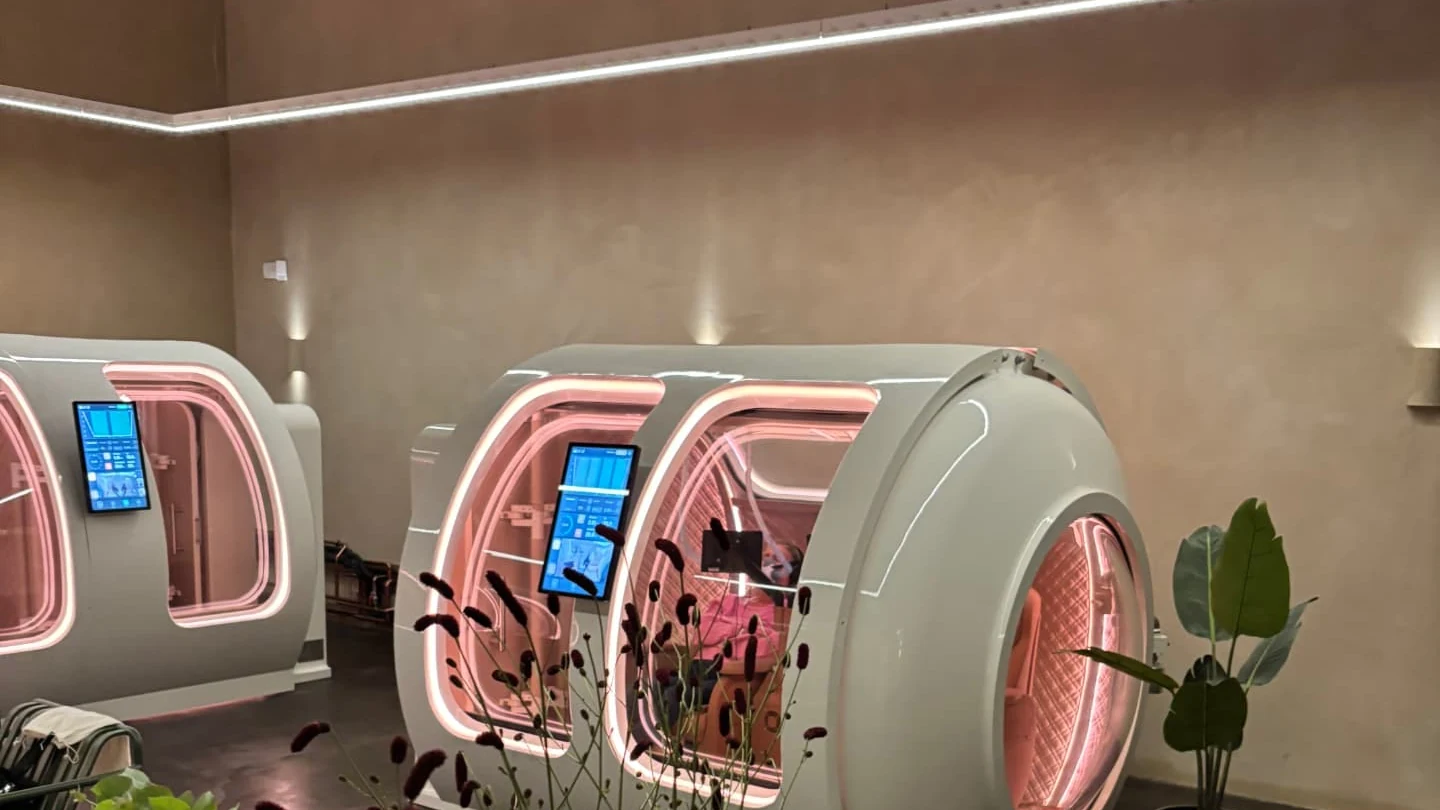
Treatment pressure is 2.0 ATA in every session, in two CE-certified hard-shell multiplace chambers with seven seats between them. Oxygen is delivered by individual mask at approximately 93% (±3%), giving an inspired oxygen pressure of about 1.86 ATA. Sessions run 65 or 95 minutes at pressure, with about ten minutes of compression and ten of decompression at either end, at 1 meter per minute. Air breaks are five minutes of air every twenty minutes. Oxygen, pressure, temperature and humidity are logged continuously, with automatic switchover to air if a reading leaves range.
Two comparisons are worth making with those numbers in hand. 2.0 ATA is 203 kPa, which is the lower bound of the 203 to 253 kPa range the European consensus suggests for the indications where it specifies a pressure at all. And in the Amsterdam review of 137 human studies, subjects mainly received sessions at 2 to 2.5 ATA, so the marker literature as a whole clusters in the band our protocol starts at, even though the specific receptor studies above sit above it. We have not measured these markers in our own patients, and any provider quoting inflammatory-marker figures is worth asking at what pressure they were obtained.
A note on screening
The safety record is well characterized. In a retrospective analysis of 2,334 patients at a single center, 17.4% experienced at least one adverse event, with a per-session rate of 0.72%. Middle ear barotrauma was the most common, affecting 9.2% of patients and 0.04% of sessions, and the great majority of those cases occurred in the first few sessions and resolved with rest and a decongestant. Hypoglycemia, oxygen toxicity, dizziness, anxiety, breathlessness and chest pain each occurred in 0.5 to 1.5% of patients.
Two items are specific to this topic rather than to hyperbaric oxygen generally. If you take an immunosuppressant, a systemic steroid or a biologic for an inflammatory condition, say so, not because hyperbaric oxygen is known to interact with those drugs but because the reason you are on them shapes how a course is planned and monitored. The same applies to high-dose antioxidant supplements, for the reasons in the FAQ below. Neither has been studied properly in this context.
The remaining items are the usual hyperbaric ones: untreated pneumothorax as an absolute contraindication, then uncontrolled seizure disorder, insulin-dependent diabetes, significant lung disease, pregnancy, and whether you can equalize middle ear pressure. Both lists are short and both are covered in a few minutes at intake, which is the practical case for doing this somewhere that asks.
Frequently asked questions
So is hyperbaric oxygen anti-inflammatory or not?
It reduces specific inflammatory measures without behaving like an anti-inflammatory drug. Immunomodulatory is the more accurate word. Recruitment of neutrophils into tissue is selectively reduced while their ability to kill bacteria is preserved or improved, which is why it appears in infection protocols that no immunosuppressant could appear in.
Will it interfere with my immune system?
Nothing in the human data suggests general immune suppression, and the accepted use of hyperbaric oxygen in serious infection is the strongest evidence against that reading. The one open question comes from the healthy-volunteer study, where neutrophil phagocytosis fell after repeated sessions. It has not been followed up, so it is worth knowing rather than worrying about.
How many sessions before inflammatory markers change?
In the best human study, circulating TNF-alpha and IL-1beta did not shift measurably until around the twelfth session, then stayed lower for at least a month. Nothing was detectable at sessions 4 or 8, though the messenger RNA for both cytokines fell earlier. That is one study in one population, so treat twelve as an observation rather than a threshold.
Why do the pathway diagrams online look so definitive?
Because most of the individual arrows were demonstrated in animal or cell models, where they hold. Assembling them into one human cascade is an inference. The honest version has firm ground at the receptor level, contested ground on antioxidant enzymes, and unsettled ground on which way HIF-1alpha moves in people.
Can I take antioxidants alongside a course?
Raise it with whoever plans your course, because there is real data here rather than only theory. Work on hyperbaric DNA damage found vitamin C, vitamin E and N-acetylcysteine ineffective at preventing it, while an orally effective plant-derived superoxide dismutase was effective. Nobody has tested whether high-dose antioxidants blunt the anti-inflammatory effect specifically, so that part remains a judgment call.
- 1.Baiula M, Greco R, Ferrazzano L, Caligiana A, Hoxha K, Bandini D, Longobardi P, Spampinato S, Tolomelli A. Integrin-mediated adhesive properties of neutrophils are reduced by hyperbaric oxygen therapy in patients with chronic non-healing wound. PLOS ONE, 2020;15(8):e0237746. Link
- 2.Thom SR, Mendiguren I, Hardy K, Bolotin T, Fisher D, Nebolon M, Kilpatrick L. Inhibition of human neutrophil beta2-integrin-dependent adherence by hyperbaric O2. American Journal of Physiology, 1997;272(3 Pt 1):C770-777. Link
- 3.Kalns J, Lane J, Delgado A, Scruggs J, Ayala E, Gutierrez E, Warren D, Niemeyer D, Wolf EG, Bowden RA. Hyperbaric oxygen exposure temporarily reduces Mac-1 mediated functions of human neutrophils. Immunology Letters, 2002;83(2):125-131. Link
- 4.Mathieu D, Marroni A, Kot J. Tenth European Consensus Conference on Hyperbaric Medicine: recommendations for accepted and non-accepted clinical indications and practice of hyperbaric oxygen treatment. Diving and Hyperbaric Medicine, 2017;47(1):24-32. Link
- 5.De Wolde SD, Hulskes RH, Weenink RP, Hollmann MW, Van Hulst RA. The effects of hyperbaric oxygenation on oxidative stress, inflammation and angiogenesis. Biomolecules, 2021;11(8):1210. Link
- 6.de Wolde SD, Hulskes RH, de Jonge SW, Hollmann MW, van Hulst RA, Weenink RP, Kox M. The effect of hyperbaric oxygen therapy on markers of oxidative stress and the immune response in healthy volunteers. Frontiers in Physiology, 2022;13:826163. Link
- 7.Hadanny A, Efrati S. The hyperoxic-hypoxic paradox. Biomolecules, 2020;10(6):958. Link
- 8.Eken A, Aydin A, Sayal A, Üstündağ A, Duydu Y, Dündar K. The effects of hyperbaric oxygen treatment on oxidative stress and SCE frequencies in humans. Clinical Biochemistry, 2005;38(12):1133-1137. Link
- 9.Gröger M, Radermacher P, Speit G, Muth CM. Genotoxicity of hyperbaric oxygen and its prevention: what hyperbaric physicians should know. Diving and Hyperbaric Medicine, 2008;38(4):200-205. Link
- 10.Speit G, Dennog C, Radermacher P, Rothfuss A. Genotoxicity of hyperbaric oxygen. Mutation Research, 2002;512(2-3):111-119. Link
- 11.Hadanny A, Meir O, Bechor Y, Fishlev G, Bergan J, Efrati S. The safety of hyperbaric oxygen treatment: retrospective analysis in 2,334 patients. Undersea and Hyperbaric Medicine, 2016;43(2):113-122. Link
- 12.Kahle AC, Cooper JS. Hyperbaric physiological and pharmacological effects of gases. StatPearls, NCBI Bookshelf, updated 2026. Link
- 13.Hyperbaric therapy for wound healing. StatPearls, NCBI Bookshelf. Link