The short version
Your red blood cells are already close to saturated. Breathing harder will not change that, and neither will breathing pure oxygen at ordinary pressure, because there is no space left in them.
The one component of blood with room to spare is plasma, and the amount of oxygen plasma holds is governed by a single variable: pressure. At 2.0 ATA on 100% oxygen, plasma carries roughly fifteen times the oxygen it carries at sea level. That is not an incremental gain. It is an additional delivery route switching on, one that reaches tissue red blood cells cannot.
2.0 ATA is also the floor of the professional definition of hyperbaric oxygen therapy, and the pressure at which the most important human studies in the field were conducted.
One session can double your circulating stem cells
If there is one experiment that shows what 2.0 ATA actually does to a person, it is this one. Stephen Thom's group at the University of Pennsylvania published it in 2006, in the American Journal of Physiology.
They gave twenty-three volunteers two hours of oxygen at 2.0 ATA. Their circulating CD34+ stem and progenitor cells doubled after that single session, and rose eightfold over a course of twenty. Total white cell count did not budge, so this was not the immune system waking up generally. It was bone marrow releasing regenerative cells specifically. The mechanism turned out to run on nitric oxide: in mice bred without the gene for endothelial nitric oxide synthase, the effect vanished completely.
Two details in that paper get less attention than they deserve.
The accidental control group
Three paramedic attendants sat inside the chamber alongside the patients. Same chamber, same 2.0 ATA, same two hours. The only difference was that they breathed chamber air instead of pure oxygen. Their CD34+ cells did not rise at all.
Three people is not a controlled experiment and should not be read as one. But it points at something the marketing around this field routinely blurs: pressure alone appears to have far smaller effects than pressure combined with a high oxygen fraction. The two multiply rather than add, and a chamber that raises one without the other is not simply a weaker version of the same intervention.
The same paper mentions something else worth knowing if you read animal studies. This protocol, 2.0 ATA for one to two hours, barely registers in mice, which need about 2.8 ATA for the same effect. Rodent dose curves do not transfer to people.
Your hemoglobin is already 97 percent full
Your blood moves oxygen two ways: bound to hemoglobin inside your red cells, and dissolved directly in the plasma they float in.
Hemoglobin normally does nearly all the work, carrying around 19 to 20 mL of oxygen in every 100 mL of blood. Right now, breathing room air, yours is already about 95 to 97% saturated. Each molecule holds four oxygen molecules at most, and nothing will persuade it to hold a fifth.
That ceiling is why this whole field exists. Breathe pure oxygen at normal pressure and your hemoglobin barely notices, creeping from roughly 19 to 20 mL. Meanwhile the dissolved plasma oxygen climbs from about 0.32 mL to 2.09 mL. Almost the entire gain arrives through the route nobody thinks about.
And that route has no ceiling. It follows Henry's law: the more pressure you put on a gas, the more of it dissolves into the liquid beneath. Double the pressure, double the dissolved gas. There is no saturation point to run into, which makes pressure the only lever here with real headroom left.
| Condition | Dissolved O₂ per 100 mL blood |
|---|---|
| Room air, sea level (1 ATA) | ~0.3 mL |
| 100% oxygen, sea level (1 ATA) | ~2.1 mL |
| 100% oxygen at 2.0 ATA | ~4.4 mL |
| 100% oxygen at 3.0 ATA | ~6.8 mL |
At 2.0 ATA, plasma alone almost covers resting demand
Those numbers stay abstract until you set them against demand. At rest, your tissues take roughly 5 to 6 mL of oxygen out of every 100 mL of blood that passes through them. At 2.0 ATA, the oxygen dissolved in plasma alone comes close to covering that on its own. At 3.0 ATA it covers more than all of it.
The 1959 experiment that settled the question
Someone tested this directly. In 1959 the Dutch surgeon Ite Boerema published a study the field still knows as Life Without Blood. His team replaced the blood of piglets with a plasma-like solution until hemoglobin fell to around 0.4 g/dL, far below what normally keeps an animal alive. Held at 3 ATA, the animals stayed stable for 45 minutes on dissolved oxygen alone, then recovered without incident once their blood went back. It remains one of the most cited papers in hyperbaric medicine, because it settled that dissolved plasma oxygen is a real second route of delivery rather than a rounding error.
That matters in three ways well beyond such an extreme setting.
Oxygen reaches tissue your red cells cannot. Red cells are bulky and need an open capillary. Plasma just diffuses. In tissue that is swollen, scarred or partly cut off, the distance from a working capillary to a struggling cell can be further than oxygen normally travels. Put more oxygen into the plasma and you steepen the gradient pushing it across that gap.
The increases are large, not marginal. The Undersea and Hyperbaric Medical Society's own physiology review puts a session at 2 ATA at roughly 125% more total blood oxygen, and about ten times the oxygen tension in tissue.
Some biology runs on thresholds, not slopes. Fibroblast replication, collagen deposition, new vessel growth and the ability of white cells to kill bacteria all stall below a certain local oxygen level, and chronic wounds routinely sit under it. Lifting tissue over that line is a different kind of intervention from topping up tissue that already had enough, which is why hyperbaric oxygen transforms some situations and does nothing at all in others.
Less blood flow, more oxygen: the vasoconstriction paradox
Here is the part that catches people out, clinicians as often as patients.
Hyperbaric oxygen narrows your blood vessels. It cuts blood flow to the extremities by about 20%, which sounds like precisely the wrong thing to do.
It is not, because the blood that still arrives is carrying so much more oxygen that the tissue ends up strongly hyperoxic on less of it. And less blood going in, with the same amount coming out, means about 20% less swelling.
That combination matters more than it sounds, because crush injuries, compartment syndromes and many chronic wounds are stuck in a loop that feeds itself. Swelling pushes the cells further from their oxygen supply. The resulting hypoxia damages them. Damaged cells leak fluid. The swelling gets worse. Cutting the swelling and raising oxygen delivery at the same time attacks that loop from both ends at once, which is the clearest illustration of why more blood flow and more oxygen are not the same thing.
Why the pressure has to come off again
The intuitive model is that hyperbaric oxygen works by flooding tissue with oxygen, and that the flooding is the therapy. That accounts for the acute indications. It does not account for why a course of twenty or sixty sessions produces changes persisting long after the oxygen has cleared.
The hyperoxic-hypoxic paradox
The proposed explanation is set out in a 2020 review by Hadanny and Efrati in Biomolecules. Cells do not measure absolute oxygen, they respond to fluctuation. When you leave the chamber and oxygen tension falls back toward normal, the fall itself registers as a hypoxic signal, despite the surrounding air being entirely ordinary.
The machinery is specific. Repeated hyperoxic exposure raises antioxidant scavenger levels, and those scavengers persist longer than the reactive oxygen species they neutralize. On return to normoxia after several sessions the ratio of species to scavengers is low, mimicking hypoxia. Less HIF-1α is degraded, more reaches the nucleus, and the downstream program runs: VEGF, sirtuins, mitochondrial biogenesis, stem cell proliferation and migration. Hypoxia's regenerative cascade, without the hypoxia. It also explains why air breaks sit inside protocols rather than being a safety afterthought, since on this model the oscillation is part of the mechanism, not an interruption to it. It is one reason our chambers monitor oxygen continuously and switch between oxygen and air automatically when a reading moves out of range, rather than relying on a fixed timer alone.
Telomere length increased by over 20 percent after 60 sessions
The most cited clinical result in this area comes from the Sagol Center in Israel and was published in Aging in 2020. Thirty-five healthy adults aged 64 and over were enrolled for 60 daily sessions at 2 ATA, 90 minutes each with five-minute air breaks every 20 minutes, breathing oxygen by individual mask in a multiplace chamber. Telomere length in T helper, T cytotoxic, natural killer and B cells rose by more than 20%. Senescent T helper cells fell by around 37%. Intracellular HIF-1α roughly doubled by the 60th session and returned toward baseline within two weeks of stopping, which is what the hyperoxic-hypoxic model predicts.
Those are large effects on two of the most established markers of cellular aging, and the protocol was 2 ATA, which is why the number matters beyond wound care.
Study limitations
The authors state these plainly themselves, and they are frequently omitted when the study is cited.
- Single-arm prospective trial with no control group. It is often described online as a randomized controlled trial. It was not.
- Small numbers. Of 35 enrolled, 30 completed baseline assessment, and the telomere and senescence analyses rest on 25 and 20 participants.
- Biomarkers, not health outcomes. Telomere length and senescent cell counts describe biological state, not clinical benefit.
- Duration unknown. How long the effect persists was not established.
- Declared conflicts. Several authors work for or hold shares in a commercial hyperbaric company.
The result is important. It is not the same thing as a demonstrated clinical benefit.
Why 2.0 ATA and not higher
Higher pressure dissolves more oxygen, so the reasonable question is why treatment stops at two atmospheres. Part of the answer is the risk curve. Central nervous system oxygen toxicity, the Paul Bert effect, is dose-dependent and climbs steeply with pressure. Across hyperbaric practice the risk sits at roughly 1 in 2,000 to 3,000 treatments, rising to about 1 in 200 at 2.8 to 3.0 ATA and falling to around 1 in 10,000 at 2 ATA or below. A retrospective review of more than 80,000 patient-treatments recorded just two seizures, both at 2.4 ATA. Scheduled air breaks reduce it further.
The more interesting part of the answer comes from the only direct human comparison of the two pressures.
Does pressure above 2.0 ATA add benefit?
In 2014 Heyboer and colleagues, working with Thom, sampled blood from twenty patients treated at either 2.0 or 2.5 ATA before and after the 1st, 10th and 20th session.
Both protocols reliably doubled circulating CD34+ counts, and raw counts ran higher in the 2.5 ATA group at the later timepoints. But what matters for regeneration is what those cells contained. Intracellular hypoxia-inducible factors 1, 2 and 3, thioredoxin-1 and poly-ADP-ribose polymerase were all twice as high after treatment as before, with no significant difference between the two pressures.
In this study, the extra pressure recruited more cells without making them more capable. The regulatory proteins driving the regenerative cascade, HIF foremost among them, had already plateaued at 2.0 ATA. Since the hyperoxic-hypoxic paradox is proposed to operate through that pathway, the signal that matters may plateau at two atmospheres, with further pressure buying cell count rather than cell function. That is one comparison in twenty patients, so it is suggestive rather than settled.
The field has settled in the same place. Hadanny and Efrati's protocol guidance caps oxygen partial pressure at 2.4 ATA with air breaks every 20 to 30 minutes, and every human study on this page was run at 2.0 ATA. That is the pressure the evidence base was built on, which is a better reason to use it than any argument about dissolving more gas.
Higher pressure remains correct where a specific tissue target must be reached. Halting alpha-toxin production in clostridial gas gangrene requires tissue oxygen tensions near 250 mmHg and treatment at 3.0 ATA. Those are acute, short-course hospital indications with a defined endpoint. For elective, repeated use, benefit and risk are best matched at two atmospheres.
Medical hyperbaric practice does go a good deal higher than 2.0 ATA, though not for the reason most people assume. Approved indications are treated between 2.0 and 3.0 ATA. For arterial gas embolism and severe decompression sickness, hospital recompression chambers go far deeper still, and US Navy treatment tables reach 165 feet of seawater, about 6 ATA.
Notice what stays fixed even there. Inspired oxygen pressure is held at or below 2.8 ATA throughout those tables, and the extra depth is reached on nitrox or heliox rather than pure oxygen, because its purpose is crushing gas bubbles rather than delivering more oxygen. The ceiling on oxygen itself has sat in roughly the same place for decades, set by the toxicity curve above rather than by engineering.
So the range of pressures in medical use is wide, and almost all of it is unrelated to oxygen dose. We treat at 2.0 ATA, which sits at the bottom of the therapeutic range and well inside the oxygen ceiling.
2.0 ATA is also where the definition begins
The UHMS specifies that hyperbaric oxygen therapy requires a hard-sided, certified pressure vessel taken to "not less than 2.0 ATA", typically for 90 to 120 minutes, and notes that scientifically supported treatments generally fall between 1.9 and 3.0 ATA. Treatment below 1.5 ATA, marketed as "mild hyperbaric oxygen" and usually delivered in soft-shelled chambers, is classed by the society as unproven.
If you are weighing a home or soft-shell chamber, the next section puts a number on that boundary.
Where the evidence runs out
The best pressure for each condition is unsettled. The UHMS registry is gathering data right now on 2.0 versus 2.4 ATA in late radiation injury. Nobody runs that comparison if the answer is known.
No dose-response curve exists for regenerative goals. Hadanny and Efrati concede in their own review that the "dose response-curve has yet to be discovered", and the Sagol team agree. Any precise longevity protocol is extrapolation from biomarker studies.
The lower boundary is contested, not closed. The UHMS calls sub-1.5 ATA unproven while acknowledging, on the same page, a positive randomized brain-injury trial run at 1.5 ATA.
Low pressure may not be free. A 2024 case series in Frontiers in Neurology reports cumulative CNS oxidative stress after repeated sessions at and below 1.5 ATA. Not a trial, but if you stack sessions assuming low pressure costs nothing, read it.
Biomarkers are not outcomes. Mobilized stem cells, longer telomeres and cleared senescent cells measure biological state, not health. Nobody has bridged the two for longevity, and assuming otherwise is the commonest error here. Advocates and skeptics both make it.
Many reasons people come here are not on the approved list. Fifteen indications are UHMS-approved; several common motivations are not among them, and the FDA has said plainly that "some claims of what it can do are unproven". Off-list is not useless, since today's standard indications were investigational once, but it does mean deciding under real uncertainty.
The protocols behind the evidence
A hyperbaric dose is four variables rather than one. Pressure sets how much oxygen dissolves, oxygen fraction sets how much of that gas is oxygen, time at pressure sets total exposure, and air breaks interrupt it, lowering toxicity risk and, on the hyperoxic-hypoxic model, contributing to the signal itself. Protocols are specified as a package, which is why knowing the parameters is what lets you compare one arrangement with another.
Why inspired oxygen pressure is the figure to compare
Pressure and oxygen fraction are usually quoted separately, which makes offers hard to compare. Dalton's law collapses them into one figure: the oxygen partial pressure you actually inhale is chamber pressure multiplied by oxygen fraction.
At 2.0 ATA on 100% oxygen that is 2.0 ATA of inspired oxygen. At 2.0 ATA on 93% it is about 1.86 ATA, some 93% of the research dose. At 1.3 ATA on 40%, a common soft-chamber arrangement, it is around 0.5 ATA, and even at a generous 90% a 1.3 ATA chamber reaches only about 1.17 ATA.
The gap between a certified chamber at 2.0 ATA and a soft-shell at 1.3 ATA is therefore not a matter of degree, and oxygen enrichment alone does not close it, because the pressure term does most of the work. It is also why Thom's attendants, at full pressure but breathing chamber air, showed nothing.
| Protocol | Pressure | O₂ fraction | Inspired O₂ | Session | Air breaks |
|---|---|---|---|---|---|
| Thom 2006 | 2.0 ATA | 100% | ~2.0 ATA | 120 min | Not stated |
| Heyboer 2014 | 2.0 or 2.5 ATA | 100% | ~2.0 / 2.5 ATA | Not stated | Not stated |
| Hachmo 2020 | 2.0 ATA | 100% by mask | ~2.0 ATA | 90 min | 5 min every 20 min |
| UHMS definition | Not less than 2.0 ATA | Not specified here | n/a | 90 to 120 min | Varies |
| Typical soft chamber | 1.3 ATA | ~40% | ~0.5 ATA | Varies | None |
One architectural detail is worth drawing out, because it is often misunderstood. The Sagol telomere protocol was not run in a single-occupancy tube filled with oxygen. It used a multiplace chamber pressurized with air, with 100% oxygen delivered to each participant through an individual mask. Mask delivery inside a certified multiplace vessel is the standard research and clinical arrangement, not a compromise on it.
How this compares with our own protocol
The arithmetic above should apply to us as readily as to anyone else, so here are our numbers.
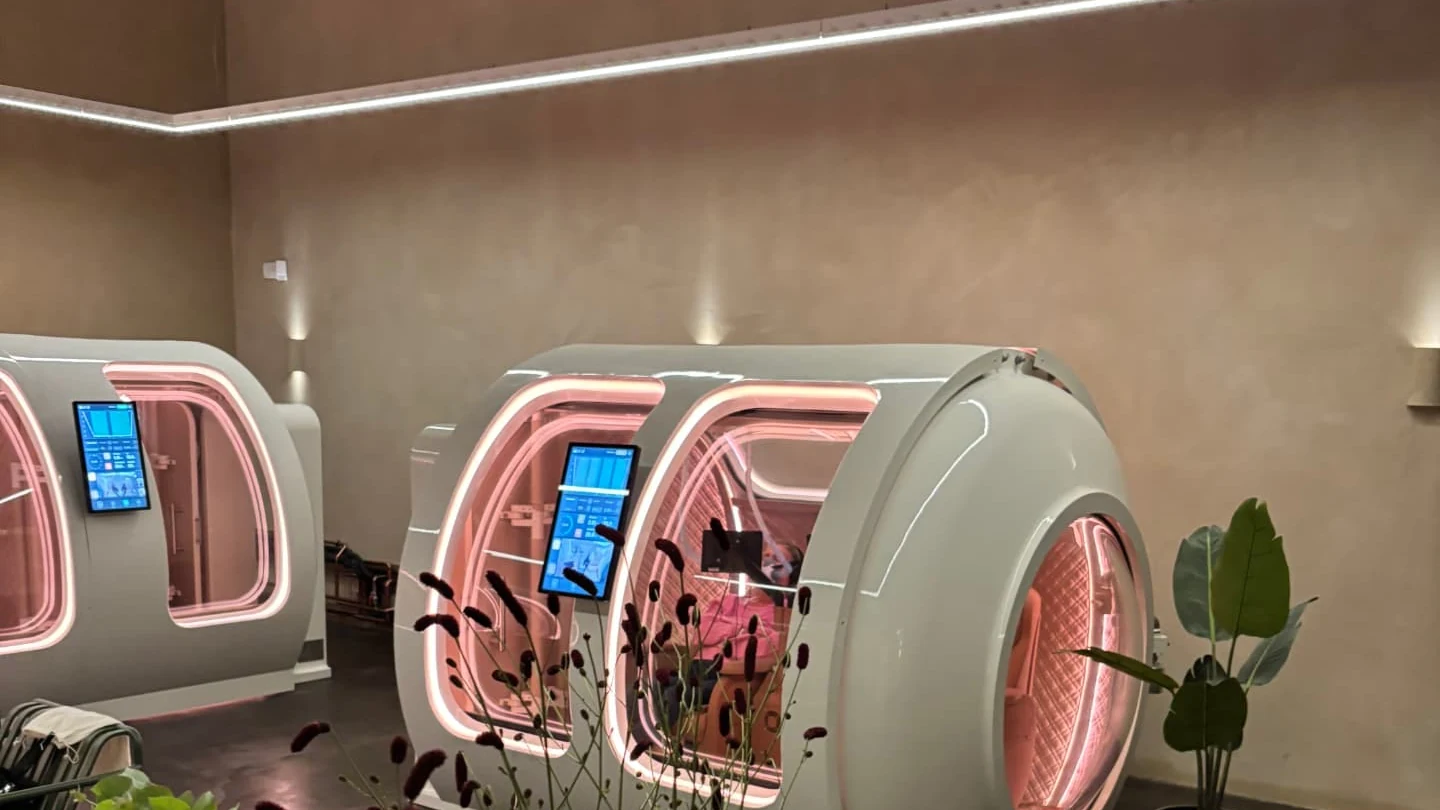
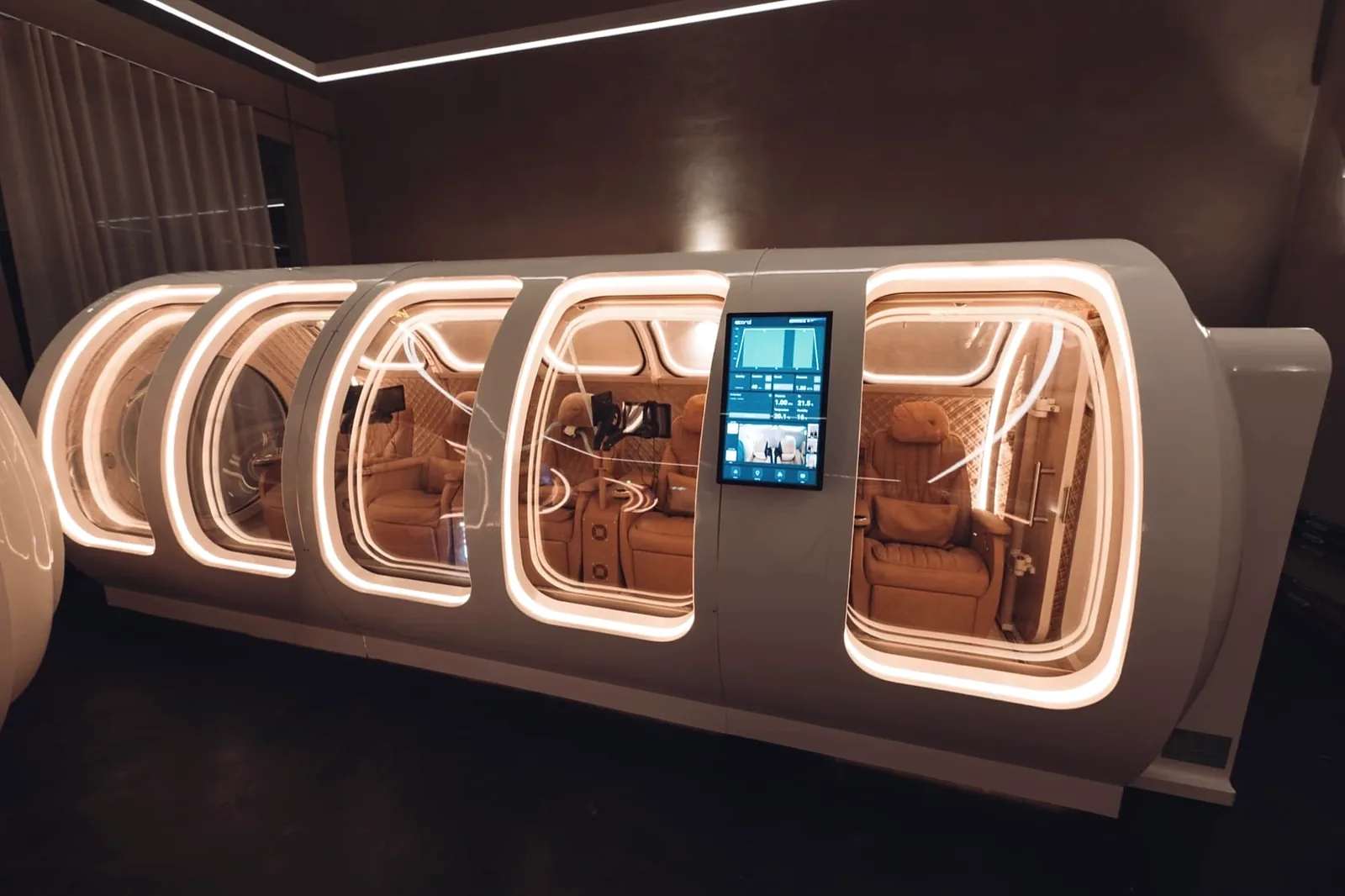
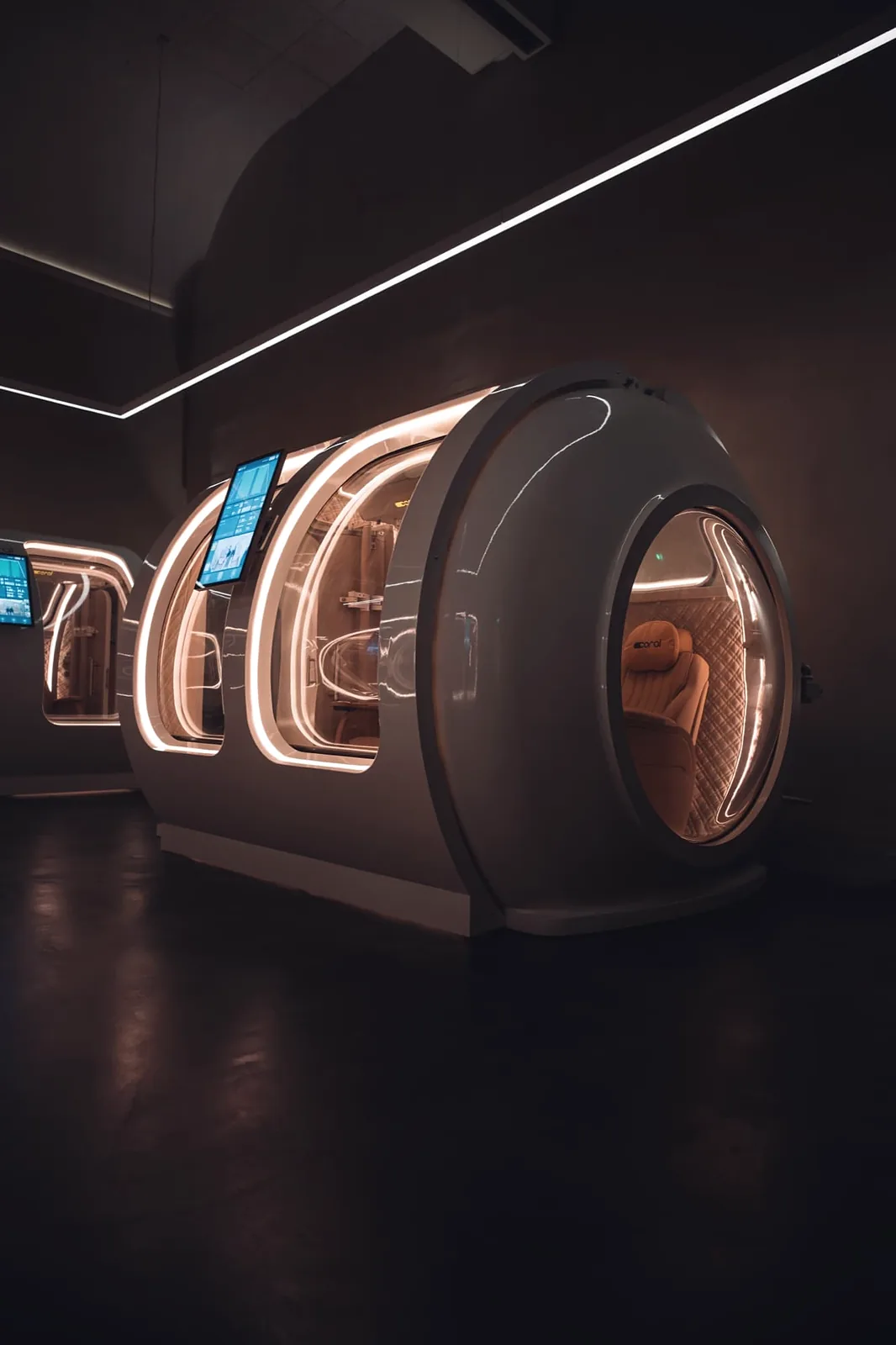
Age Back Clinics run two CE-certified hard-shell multiplace chambers, seven seats between them, at a treatment pressure of 2.0 ATA. Oxygen is delivered to each person through an individual mask at approximately 93% (±3%), which works out to an inspired oxygen pressure of about 1.86 ATA. A session is 65 or 95 minutes, with roughly ten minutes of compression at each end; the 95-minute option covers the Sagol protocol exactly and sits inside the UHMS range of 90 to 120 minutes. Oxygen concentration, pressure, temperature and humidity are logged continuously for every session.
Two things follow from those numbers. The treatment pressure, the certified hard-shell vessel and the individual-mask delivery are the architecture of the research literature rather than an approximation of it: the Sagol telomere protocol was run in exactly this configuration, a multiplace chamber pressurized with air and oxygen supplied by mask. And on the figure that actually matters, 1.86 ATA sits near the 2.0 ATA of the published protocols and a long way above the 0.5 to 1.17 ATA of the low-pressure chambers marketed for home use.
Run the same calculation on any provider you are weighing up, including this one.
A note on screening
Hyperbaric oxygen at 2.0 ATA has a strong safety record, and the numbers above are the evidence: two seizures across more than 80,000 treatments, both at higher pressure. The usual complaint is ear pressure during compression, which resolves. Screening exists because a small number of specific conditions change the calculation. We ask about all of these before a first session, and so should any supervised facility.
- An undrained pneumothorax is the one absolute contraindication. Trapped gas expands as pressure comes off.
- Bleomycin and certain other chemotherapy agents, current or recent, because of their interaction with high oxygen concentrations.
- A history of seizures, which is not automatically a bar. A 2025 retrospective cohort of 22 such patients across 634 sessions, mostly at 1.8 to 2.0 ATA with five-minute air breaks, recorded a single seizure event.
- Recent ear or sinus surgery, or difficulty equalising pressure.
- Poorly controlled diabetes, since blood glucose can fall during a session.
Sessions are attended throughout, and tell the operator if you feel unwell at any point, because decompression can be started immediately.
If you are weighing an unsupervised or home chamber, this list is the strongest practical argument for a supervised one. The screening conversation is the part that does not come in the box.
One last point, which applies to any adjunctive therapy. Hyperbaric oxygen should sit alongside treatment that is known to work rather than in place of it. The most serious documented harm associated with this therapy is rarely the therapy itself. It is delay.
Frequently asked questions
Is 2.0 ATA the same as two atmospheres of added pressure? No, and the distinction is important. ATA means atmospheres absolute, the total pressure including the atmosphere already pressing on you at sea level. So 2.0 ATA is double sea-level pressure, roughly what you would feel 10 meters underwater, not 20. Gauge pressure, quoted as added pressure, would call the same conditions 1.0 bar.
Does higher pressure always produce a better result? No. The only direct human comparison found that 2.5 ATA mobilized more stem cells than 2.0 ATA, but the regulatory proteins inside those cells, including HIF, were identical between the two pressures. More pressure recruited more cells without making them more capable, while toxicity risk rose. There is no established benefit above 2.0 ATA for elective use.
Isn't the pressure the active ingredient? Pressure and oxygen fraction both are, and they multiply rather than add. Multiply the two together and you get inspired oxygen partial pressure, which is the single figure worth comparing between providers. Pressure alone, without a raised oxygen fraction, produces very little, as the attendants in Thom's study demonstrated.
What about home or "mild" chambers at 1.3 ATA? The UHMS classes treatment below 1.5 ATA as unproven. Applying the arithmetic above, such a chamber delivers roughly a quarter of the inspired oxygen used in the studies on this page, and even generous oxygen enrichment leaves it well short, because the pressure term does most of the work.
Should I feel something during a session? Very little, beyond ear pressure while the chamber comes up to depth. Ours takes about ten minutes to get there, and equalizing feels much like a descending aircraft. Some tiredness after early sessions is common. Sensation is a poor guide either way: feeling something is not evidence of benefit, and feeling nothing is not evidence of its absence.
- 1.Thom SR, Bhopale VM, Velazquez OC, Goldstein LJ, Thom LH, Buerk DG. Stem cell mobilization by hyperbaric oxygen. Am J Physiol Heart Circ Physiol. 2006;290(4):H1378-86. Link
- 2.Heyboer M 3rd, Milovanova TN, Wojcik S, et al. CD34+/CD45-dim stem cell mobilization by hyperbaric oxygen: changes with oxygen dosage. Stem Cell Res. 2014;12(3):638-45. Link
- 3.Hachmo Y, Hadanny A, Abu Hamed R, et al. Hyperbaric oxygen therapy increases telomere length and decreases immunosenescence in isolated blood cells: a prospective trial. Aging (Albany NY). 2020;12(22):22445-56. Link
- 4.Hadanny A, Efrati S. The hyperoxic-hypoxic paradox. Biomolecules. 2020;10(6):958. Link
- 5.Undersea and Hyperbaric Medical Society. Indications for Hyperbaric Oxygen Therapy. Link
- 6.Boerema I, Meyne NG, Brummelkamp WH, et al. Life without blood. Ned Tijdschr Geneeskd. 1960;104:949-54. Summarised in Hyperbaric Therapy in Blood Loss Anemia, StatPearls. Link
- 7.Cooper JS, Hanson KC. Hyperbaric Physics. StatPearls, NCBI Bookshelf. Link
- 8.Oxygen Toxicity. StatPearls, NCBI Bookshelf. Link
- 9.Hampson N, Atik D. Central nervous system oxygen toxicity during routine hyperbaric oxygen therapy: seizure incidence in 80,000 patient treatments. Undersea Hyperb Med. 2003;30(2):147-53. Link
- 10.Acute and chronic central nervous system oxidative stress/toxicity during hyperbaric oxygen treatment of subacute and chronic neurological conditions. Front Neurol. 2024. Link
- 11.Safety of hyperbaric oxygen therapy in non-emergent patients with a history of seizures: a retrospective cohort study. PLOS One. 2025. Link
- 12.Undersea and Hyperbaric Medical Society. Q4 2025 Update from the Multicenter Registry for Hyperbaric Oxygen Therapy. Link
- 13.US Navy. Diving Medicine and Recompression Chamber Operations, Diving Manual vol. 5, hosted by the Undersea and Hyperbaric Medical Society. Link
- 14.US Food and Drug Administration. Follow Instructions for Safe Use of Hyperbaric Oxygen Therapy Devices: Letter to Health Care Providers. Link