
The short version
Hyperbaric oxygen has real support for one specific job: chronic wounds that are failing because the tissue cannot get enough oxygen, most often diabetic foot ulcers with reduced arterial supply. In that group, pooled trial data show fewer major amputations. In ulcers where blood supply is adequate, the same research group found no benefit.
The strongest single randomized trial reported 52% healing against 29% on placebo at one year, and its own follow-up analysis showed the effect concentrated in patients whose feet could already carry some oxygen. Guidelines place it a rung below their strongest wording, and every one of them treats it as an addition to specialist wound care rather than a replacement for it.
What is settled, and what is still being tested
| Established physiology | Under active investigation |
|---|---|
| Dissolved oxygen in plasma rises in direct proportion to inspired oxygen pressure | Whether raising oxygen in the wound bed changes long-term outcomes as reliably as it changes short-term healing rates |
| Collagen cross-linking and oxidative bacterial killing are oxygen-dependent and slow in hypoxic tissue | The optimal number of sessions, currently being tested head to head for the first time |
| Chronic wounds are frequently hypoxic, and transcutaneous oximetry measures this at the skin | Whether transcutaneous oxygen thresholds derived from one trial hold up as selection criteria |
| Hyperbaric oxygen raises tissue oxygen far above what a mask at sea level can achieve | Whether pressures above 2.0 ATA add anything for wounds specifically |
52% of ulcers closed on oxygen, against 29% on pressurized air
The trial that anchors this field is Swedish. Magnus Löndahl and colleagues at Lund University ran the HODFU study, published in Diabetes Care in 2010, and it remains the most rigorous test of hyperbaric oxygen in chronic diabetic foot ulcers. They recruited 94 patients with Wagner grade 2, 3 or 4 ulcers that had been open for more than three months despite at least two months of care at a diabetes foot clinic. A vascular surgeon assessed every patient at entry.
The design is what makes it valuable. Both groups went into the same multiplace chamber and both were compressed to 2.5 ATA for 85 minutes a day, five days a week, for eight weeks. One group breathed oxygen through a mask, the other breathed air. Patients and assessors did not know which. That is a genuine placebo, not a waiting list, and it is rare in this literature.
At one year, complete healing of the index ulcer had been achieved in 25 of 48 patients on oxygen and 12 of 42 on air, 52% against 29%. Among those who completed more than 35 of the 40 planned sessions, the figures were 61% and 27%. The largest gap between the two groups appeared at nine months, which tells you something about the timescale: this is not a treatment whose effect you read off after two weeks.
Read the trial with these in mind
- Ninety-four patients at a single center. Large for this field, small in absolute terms.
- Patients were selected: adequate distal perfusion, or arterial disease that could not be surgically reconstructed. Ulcers had already resisted specialist care for months.
- Healing of one index ulcer was the endpoint. Amputation and death were reported without significance testing.
- Funding came from foundations and the university, and the authors declared no competing interests.
The same trial showed which feet responded
If you read only the headline, you would conclude that hyperbaric oxygen heals diabetic foot ulcers. The follow-up analysis is more interesting than that. Löndahl and colleagues went back to the 75 patients who had completed therapy and asked whether any baseline measurement predicted who healed.
Transcutaneous oximetry did. This is a small electrode taped to the skin that reads the oxygen tension arriving at the tissue, and in the oxygen group healing rose steadily with baseline readings on the dorsum of the foot: none of the ulcers healed below 25 mmHg, half healed between 26 and 50, and above 75 mmHg all of them did. Toe blood pressure and the ankle-brachial index predicted nothing useful. The authors suggested a threshold of 25 mmHg for offering the treatment at all.
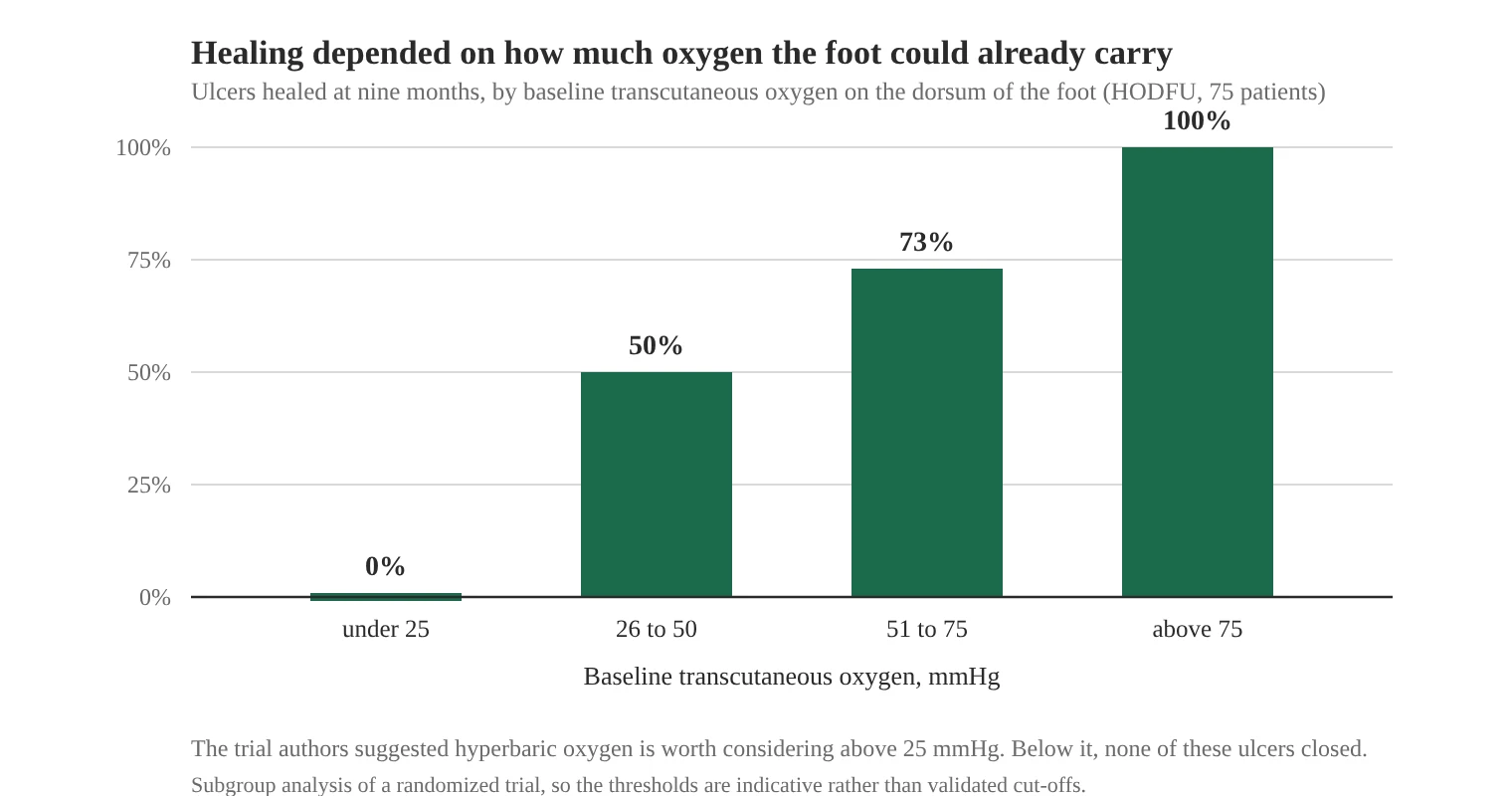
That is a subgroup analysis of 75 people, so treat the numbers as a gradient rather than as cut-offs you could apply to yourself. What it establishes is the shape of the thing. Oxygen has to reach the wound to do anything there, and a foot with no delivery capacity does not acquire one inside a chamber.
Collagen and bacterial defense saturate at different pressures
Now the physiology, because the trial result only makes sense once you know what oxygen is doing.
Oxygen in a wound is not fuel. It is a substrate for specific enzymes. Prolyl hydroxylase and lysyl hydroxylase attach hydroxyl groups to proline and lysine in the collagen chain, and without that step you get protocollagen, which has none of collagen's tensile properties. Separately, the NADPH oxidase in neutrophils and macrophages consumes oxygen to generate the superoxide and hydrogen peroxide that kill bacteria. Both enzyme systems follow saturation kinetics, and both have appetites well above what a struggling wound can supply.
The numbers come from a body of work summarized in Clinics in Plastic Surgery: collagen synthesis rises in direct relation to oxygen tension across the range 25 to 250 mmHg, prolyl hydroxylase needs more than 150 mmHg to reach 90% of its maximum speed, and the bacterial killing reaction runs at half speed somewhere between 40 and 80 mmHg, requiring around 400 mmHg to reach 90%. Below 40 mmHg, phagocytes lose most of their capacity to kill bacteria at all.
Set that against the wound itself. The middle of a chronic ulcer can sit near 10 mmHg. Healthy tissue runs around 60. So the tissue that most needs to build collagen and clear bacteria is operating at a fraction of the rate it is capable of, and it is not short of cells or growth factors. It is short of the one substrate that has to arrive by blood.
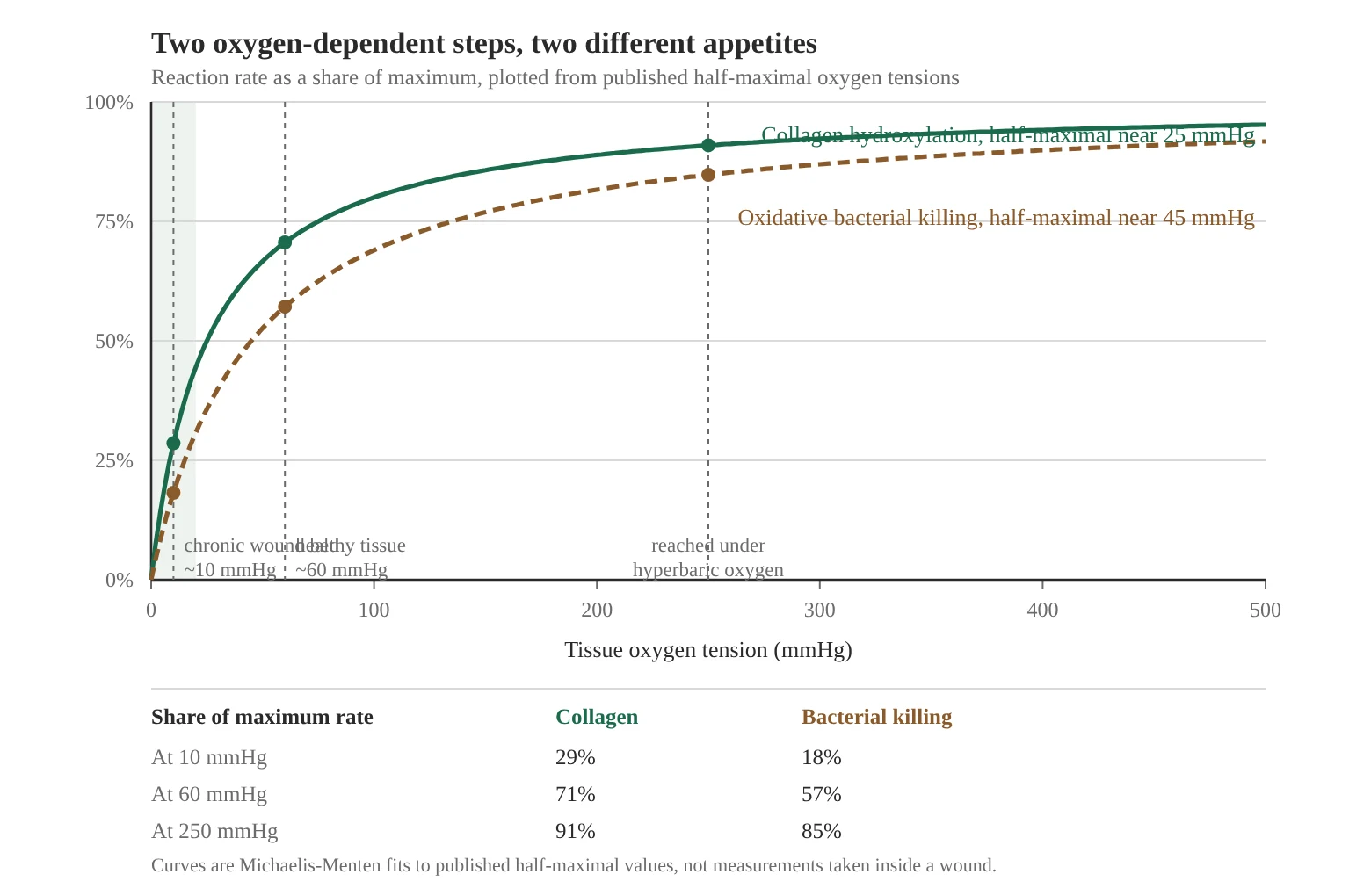
One wrinkle explains most of the confused writing on this subject. Early in repair, low oxygen is a signal rather than a problem: hypoxia drives fibroblasts and macrophages to release vascular endothelial growth factor, which is how new vessels get requested at all. The building work that follows, though, goes better in normal or raised oxygen. Hypoxia writes the order. Oxygen fills it. A wound stuck in the first phase is not helped by more of the signal.
Why pressure, rather than simply more oxygen
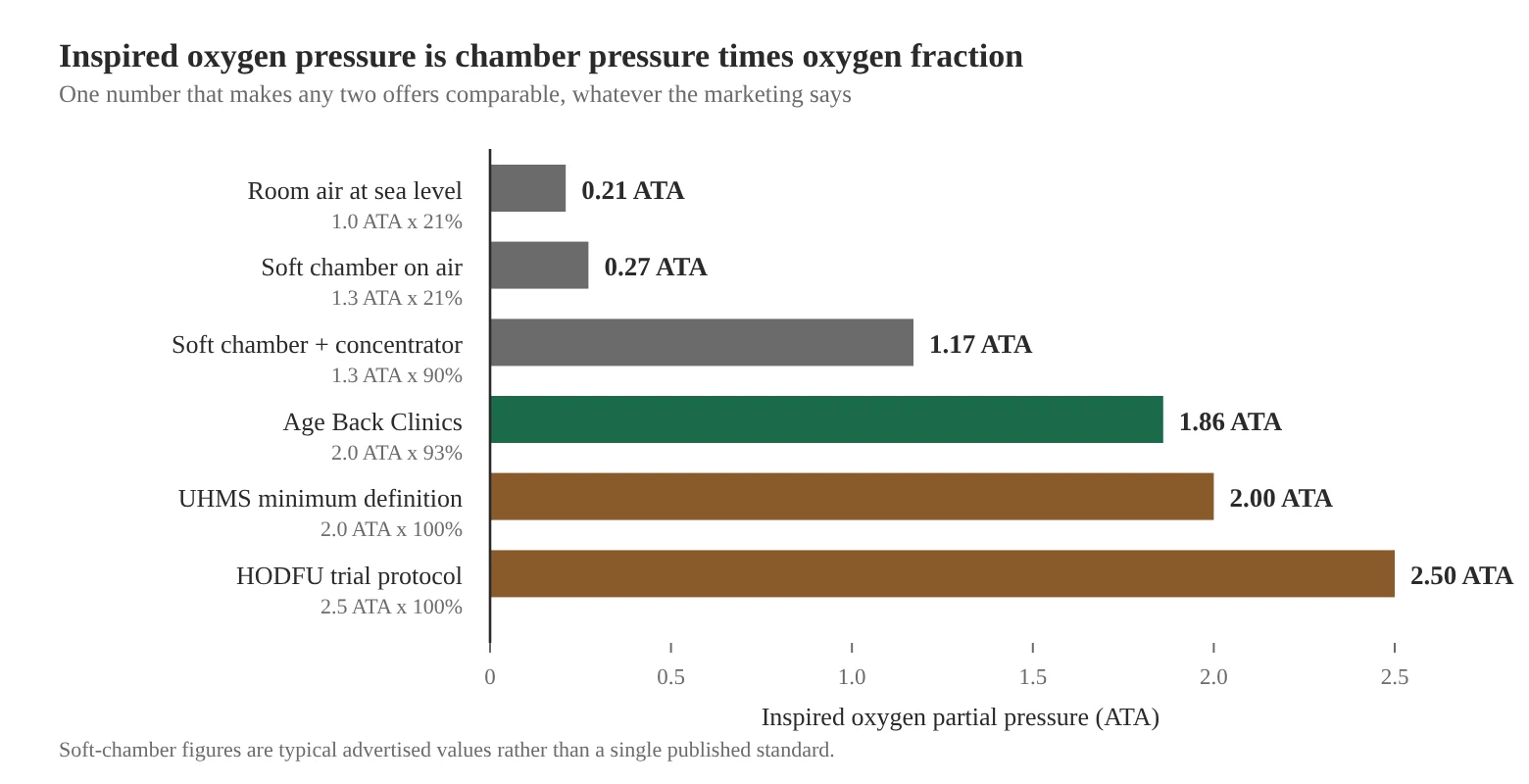
Hemoglobin is the obvious objection. Your red cells are already almost fully loaded breathing room air, so giving you a mask at sea level adds very little carrying capacity. What pressure changes is the oxygen dissolved directly in plasma, which follows the inspired pressure in a straight line with no saturation point. That dissolved fraction is what diffuses out of a capillary into tissue that vessels no longer reach properly, and it is why the treatment is measured in atmospheres rather than in liters per minute.
The number that matters is inspired oxygen partial pressure, and it is simple arithmetic: chamber pressure multiplied by the oxygen fraction you are actually breathing. At Age Back Clinics that is 2.0 ATA at approximately 93% oxygen (±3%) through an individual mask, giving about 1.86 ATA of inspired oxygen. Compression takes around ten minutes at each end of a 65 or 95 minute session. Run the same multiplication on any other offer and you can compare them directly.
European guidance makes the delivery question explicit. The ECHM's strongest wound recommendation is conditional on measuring transcutaneous oxygen under pressure, inside the chamber, and finding it above 100 mmHg in a diabetic patient. In other words the criterion is not the diagnosis and not the pressure setting. It is evidence that oxygen is arriving where the wound is.
Two later trials found no significant advantage
In 2016, Ludwik Fedorko's group in Toronto published a double-blind trial in Diabetes Care that pointed the other way. They randomized 107 patients with Wagner grade 2 to 4 ulcers to 30 daily 90-minute sessions of oxygen at 244 kPa, roughly 2.41 ATA, or to sham sessions breathing air at 125 kPa. Their primary outcome was whether patients met criteria for major amputation at 12 weeks. Criteria were met in 13 of 54 sham patients and 11 of 49 on oxygen, and healing occurred in 22% and 20% respectively. Nothing separated the groups.
Two years later the Dutch DAMO2CLES trial reported on 120 patients with diabetes and ischemic leg ulcers, randomized to standard care with or without hyperbaric oxygen. Limb salvage at 12 months was achieved in 53 patients against 47, and 30 index wounds healed against 28. Amputation-free survival favored the oxygen arm by 13 percentage points, with a confidence interval running from minus 2 to plus 28. None of it reached significance.
Read these two with these in mind
- Fedorko's endpoint was meeting criteria for amputation, adjudicated at 12 weeks, not amputation itself and not healing at a year. HODFU's advantage was widest at nine months.
- Fedorko's sham ran at a lower pressure than the treatment arm, so the two arms differed in pressure as well as in gas.
- DAMO2CLES was open-label, and its planned sample size was cut from 226 to 120 when recruitment lagged behind the sponsor's deadline.
- DAMO2CLES had more Wagner grade 3 and 4 wounds in the oxygen arm, which is the arm you would expect to do worse.
- In DAMO2CLES, 21 of 60 patients assigned to oxygen could not complete the course. Among those who did, amputation-free survival was 26 percentage points higher.
That last point is not a footnote. The Amsterdam authors said in their own response to critics that many such patients "are unable to complete a full HBOT regimen", mostly because they are too unwell, and that the priority for future work should be identifying who will benefit. They read their own null result as a selection problem rather than a mechanism problem.
The Toronto group read theirs differently, and it is worth hearing them in their own words, because they put the skeptical case better than a summary would. Responding to critics, Fedorko and colleagues wrote that "hyperbaric oxygen is a drug delivered in a large pill" and should be held to the standards applied to any other expensive drug. That is a fair demand. A course that occupies eight weeks of a patient's life and a serious share of a wound budget should not get an easier ride than a tablet would.
The split that organizes the whole literature
There is a finding that makes the disagreement tractable. In 2020 a group at Amsterdam UMC published two systematic reviews within months of each other, using the same methods on two different populations.
The first pooled four trials of diabetic foot ulcers with peripheral arterial disease. Major amputations occurred in 10.7% of the hyperbaric oxygen groups and 26.0% of controls, a risk difference of 15 percentage points, with a number needed to treat of seven. The second looked at diabetic ulcers without arterial disease and found no acceleration of healing and no reduction in amputations, concluding that routine use could not be recommended in that group, while noting that the evidence there is thin.
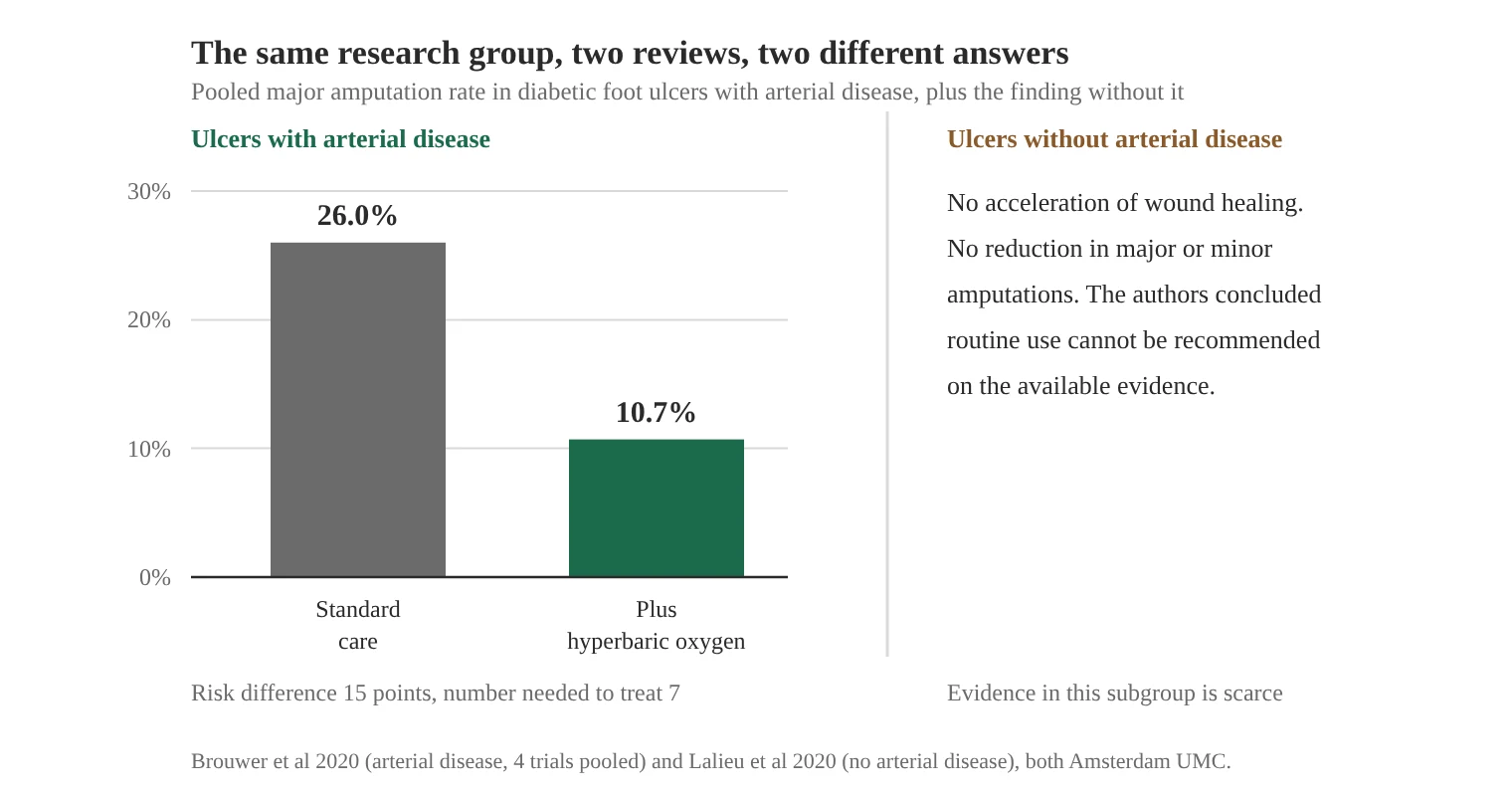
Read alongside the earlier trials, that reframes the question. Fedorko's population was not selected for ischemia. HODFU's was selected for perfusion status by a vascular surgeon. DAMO2CLES enrolled ischemic ulcers but included relatively superficial ones and lost a third of its treatment arm. The variable doing the work is not the year of publication or the quality of the blinding. It is whether the wound is failing for want of oxygen delivery in the first place.
This is also why the pooled reviews that mix everyone together look lukewarm. The 2015 Cochrane review of hyperbaric oxygen for chronic wounds found healing significantly improved at six weeks, with a risk ratio of 2.35, but "no strong evidence of a benefit" at one year or beyond, and could not confirm an effect on major amputation. That verdict is accurate for the mixed population it covers. It is not the same question as the one the ischemic-subgroup reviews asked.
What the guidelines recommend, and at what pressure
European and international bodies land in almost the same place, and their wording repays attention.
The ECHM's tenth consensus conference placed diabetic foot lesions at a Type 2 recommendation on Level B evidence, meaning that the panel suggests the treatment rather than recommending it, and ischemic ulcers at Type 2 on Level C. Its summary table records no Level A evidence for any condition as a whole. The one Level A statement anywhere in its wound section is the conditional one described above, tied to a transcutaneous oxygen reading taken under pressure. The same document is emphatic that hyperbaric oxygen should never be a stand-alone therapy, that at least four weeks of proper wound care should come first, including debridement, offloading, infection management and vascular imaging, and that patients should be screened for whether revascularization is the better answer.
The same document states, in the methodology section most readers skip, that "no evidence of a benefit is not the same as evidence of no benefit." It is one sentence and it governs how the whole list should be read.
The 2023 IWGDF guideline reaches a similar position by a different route. It suggests considering hyperbaric oxygen in neuro-ischemic or ischemic diabetes-related foot ulcers where standard care alone has failed, a conditional recommendation on low-certainty evidence. Its own rationale notes that of 18 studies, only three were double-blind, that the trials at lowest risk of bias suggest benefit for healing and ulcer area, and that good evidence for preventing amputation is lacking. It separately advises against using hyperbaric oxygen for the sole purpose of treating a foot infection.
On pressure, the Undersea and Hyperbaric Medical Society sets a floor rather than a target. Its definition of the therapy requires a hard-sided chamber and a pressure of not less than 2.0 ATA, under a physician's prescription, typically for 90 to 120 minutes. Anything below that floor is outside every approved indication, which is the practical reason a home chamber is not a smaller version of this treatment. It is a different intervention.
Radiation injury is the other wound indication with real support
If you had radiotherapy years ago and are living with tissue that will not heal, the evidence base is separate and stronger than the general wound picture. Late radiation tissue injury involves progressive loss of small vessels, which is precisely the failure mode hyperbaric oxygen addresses.
The 2023 update of the Cochrane review on this indication, which changed its conclusions from the previous version, found low to moderate certainty evidence of improved outcomes in bone and soft tissue of the head and neck, and some evidence in radiation cystitis and proctitis. It also found that newer evidence suggests no improvement in osteoradionecrosis specifically, and no effect on death at one year. The ECHM treats mandibular osteoradionecrosis, prevention of it after dental extraction, radiation cystitis and radiation proctitis as Type 1 recommendations. This is the part of the field where a longevity clinic's chamber and a hospital's chamber are doing the same recognized job.
Burns are an inpatient indication, measured in hours
Burns come up often enough to answer directly. The rationale is sound: preserve the zone of tissue around a burn that is injured but salvageable, limit edema, support graft take. The evidence is not.
The Cochrane review of hyperbaric oxygen for thermal burns found insufficient evidence to support or refute it, resting on two randomized trials of poor methodological quality, and no large trial has replaced them since. Later reviews report shorter hospital stays and less surgery in some series, with inconsistent mortality findings and studies too varied to pool.
Note also what the ECHM specifies where it does suggest burns treatment, for second-degree burns over more than 20% of body surface: sessions started within six to eight hours of injury, given twice daily, and only in highly specialized centers immediately adjacent to a burns unit, with monitoring and fluid management in place. That is intensive care with a chamber attached. It has almost nothing in common with an outpatient course, and no outpatient clinic, including ours, is the right place for it. If you are recovering from a significant burn, the question to put to your burns team is about scar management and graft healing, not about booking sessions.
Where the evidence runs out
- Short-term healing and long-term healing come apart. The pooled advantage at six weeks does not persist at a year in the mixed population. Nobody has established whether that reflects slower healing eventually catching up, recurrence, or the natural history of a population with progressive vascular disease.
- Guidelines and subgroup meta-analyses disagree about amputation. IWGDF says good evidence for preventing amputation is lacking. The ischemic-subgroup pooling finds a 15-point difference. Both are defensible readings of overlapping data, and the disagreement is about which patients belong in the analysis.
- The dose is unknown. Trials have used 20 to 40 sessions at 2.2 to 2.5 ATA because that is what precedent suggested, not because anyone compared them. That is now being tested: the DIONYSIUS trial, an international multi-arm design that began recruiting in 2021, randomizes patients with ischemic ulcers to standard care with 0, 20, 30 or at least 40 sessions, with major amputation at 12 months as its endpoint and up to 573 patients planned.
- The wound trials sit above the pressure most wound clinics use. HODFU ran at 2.5 ATA and Fedorko at 2.41. Practice for diabetic foot ulcers, ours included, has converged on 2.0 ATA, the UHMS floor. Whether pressures above 2.0 add benefit for wounds has not been tested head to head, so treat any confident claim in either direction with suspicion.
- Completing the course may be part of the treatment effect. Per-protocol results consistently beat intention-to-treat results here. That could mean the dose matters, or it could mean healthier patients both finish and heal. Those two explanations have very different implications and the trials cannot separate them.
- Transcutaneous thresholds are indicative. The 25 mmHg figure comes from a subgroup of 75 patients in one trial, and the ECHM's 100 mmHg under-pressure criterion depends on equipment many centers do not have.
The protocols behind the evidence
Parameters below are taken from published methods rather than abstracts. Where a paper did not report a value, the cell says so.
| Study | Pressure | Gas and delivery | Time at pressure | Course | Comparator | Primary endpoint |
|---|---|---|---|---|---|---|
| HODFU, Löndahl 2010 | 2.5 ATA | 100% oxygen by mask, multiplace chamber | 85 min, plus 5 min compression and 5 min decompression | 40 sessions, 5 days a week, 8 weeks | Hyperbaric air at the same pressure, double-blind | Index ulcer healed at 1 year |
| Fedorko 2016 | 244 kPa, about 2.41 ATA | Oxygen; delivery method not stated in the abstract | 90 min | 30 daily sessions | Air at 125 kPa, about 1.23 ATA, double-blind | Meeting criteria for major amputation at 12 weeks |
| DAMO2CLES, Santema 2018 | Not reported in the sources consulted | Not reported in the sources consulted | Not reported in the sources consulted | Up to 40 sessions | Standard care alone, open-label | Limb salvage and wound healing at 12 months |
| DIONYSIUS, recruiting | 2.2 to 2.5 ATA | 100% oxygen by mask or hood, with three 5 min air breaks | 90 to 120 min | 0, 20, 30 or 40 or more sessions, at least 5 a week | Standard care with no sessions, open-label | Major amputation at 12 months |
How this compares with our own protocol
We treat at 2.0 ATA in two CE-certified hard-shell multiplace chambers with seven seats between them. Oxygen is delivered by individual mask at approximately 93% (±3%). Sessions run 65 or 95 minutes, with roughly ten minutes of compression at each end. Oxygen, pressure, temperature and humidity are logged continuously, with automatic switchover between oxygen and air if any reading leaves range.
Set against the research protocols, that is 2.0 ATA of inspired oxygen where HODFU used 2.5 and DIONYSIUS uses 2.2 to 2.5. Set against a home chamber at 1.3 ATA, it is a different order of exposure entirely. Both comparisons are worth making, and the arithmetic in the figure above lets you make either one for yourself.
The other disclosure matters more. Wound care itself is a specialist pathway, and the guidelines are explicit that hyperbaric oxygen belongs inside it rather than beside it: four weeks of proper standard care first, vascular imaging to establish whether revascularization is the better option, debridement, offloading, infection management, and ongoing review by the team that knows the wound. We are not a diabetes foot clinic or a vascular service. If you are managing an ulcer that will not close, the first conversation is with the team responsible for it, and any hyperbaric course should be agreed with them rather than arranged around them.
A note on screening
The safety record in this population is good and well documented. HODFU delivered 3,225 chamber treatments without a single case of decompression sickness, seizure or pneumothorax, and reported a low overall rate of adverse events.
The common problems are pressure-related rather than oxygen-related. Middle ear barotrauma is the most frequent, reported at around 2% of patients in one review of 31,599 treatments, and higher in prospective studies that look for it deliberately. Sinus barotrauma is next. Oxygen toxicity seizures are rare, traditionally quoted at roughly one in 10,000 treatments and more likely as pressure rises, which is one of the arguments for treating at 2.0 rather than higher when 2.0 will do. A temporary myopic shift, meaning a drift toward short-sightedness, can develop over a long course and usually resolves after it ends.
Before a first session we ask about ear and sinus problems and recent surgery to either, any history of pneumothorax or significant lung disease, seizures, pregnancy, certain chemotherapy agents, and pacemakers or implanted devices. Untreated pneumothorax is an absolute barrier. If you have diabetes and take insulin or a sulfonylurea, blood glucose is checked before and after sessions, because glucose tends to fall during treatment and a long course amplifies the effect. For comparison, the DIONYSIUS trial excludes severe epilepsy, end-stage renal disease on dialysis, recent chest or middle ear surgery, pregnancy, and recent chemotherapy or systemic corticosteroids, which is a reasonable picture of who a supervised program screens out.
Frequently asked questions
How many sessions would a course involve?
Trials in this indication have used 20 to 40 sessions, five days a week, over four to eight weeks. Nobody has established the right number, which is exactly what the DIONYSIUS trial is testing. Session count for any individual is a clinical decision made with the team managing the wound, and any provider who quotes a round number without reasoning attached has no reasoning attached.
Will it work if my circulation is very poor?
That is the central question, and the honest answer is that very poor delivery predicts poor response. In the HODFU follow-up, no ulcer healed in patients whose baseline transcutaneous oxygen was below 25 mmHg. Transcutaneous oximetry is the measurement that answers this, and European guidance treats it as the selection tool. Ask for it before committing to a course.
Is a home chamber a smaller version of this?
No. It is a different exposure. Every approved hyperbaric indication requires at least 2.0 ATA in a hard-sided chamber, and no wound trial has been run below that. A chamber at 1.3 ATA delivers well under half the inspired oxygen pressure, and none of the evidence in this guide applies to it.
Can hyperbaric oxygen treat the infection in my ulcer?
Not on its own, and not as the reason to start. Oxygen does restore the oxidative killing that neutrophils depend on, which is part of the mechanism, but the 2023 IWGDF guideline specifically advises against using hyperbaric oxygen for the sole indication of treating a diabetes-related foot infection. Antibiotics, debridement and surgical management remain the treatment for that.
Does it help ordinary surgical wounds or sports injuries heal faster?
Those are separate questions with much weaker evidence, and none of the trials in this guide addresses them. What the wound literature supports is chronic non-healing tissue with a delivery problem. Applying findings from ischemic ulcers to a healthy person's post-operative scar is the most common overreach in this field.
What does the treatment actually feel like?
Pressurization takes about ten minutes and feels like descending in an aircraft, with the same need to clear your ears by swallowing or yawning. At pressure you sit and breathe through a mask, and most people read or listen to something. Decompression takes about as long as compression. The most common complaint afterwards is mild ear discomfort.
- 1.Löndahl M, Katzman P, Nilsson A, Hammarlund C. Hyperbaric oxygen therapy facilitates healing of chronic foot ulcers in patients with diabetes. Diabetes Care, 2010;33(5):998-1003. Link
- 2.Löndahl M, Katzman P, Hammarlund C, Nilsson A, Landin-Olsson M. Relationship between ulcer healing after hyperbaric oxygen therapy and transcutaneous oximetry, toe blood pressure and ankle-brachial index in patients with diabetes and chronic foot ulcers. Diabetologia, 2011;54(1):65-8. Link
- 3.Rodriguez PG, Felix FN, Woodley DT, Shim EK. Oxygen in wound healing: nutrient, antibiotic, signaling molecule, and therapeutic agent. Clinics in Plastic Surgery, 2012. Link
- 4.Fedorko L, Bowen JM, Jones W, et al. Hyperbaric oxygen therapy does not reduce indications for amputation in patients with diabetes with nonhealing ulcers of the lower limb. Diabetes Care, 2016;39(3):392-9. Link
- 5.Fedorko L et al. Response to comments on Fedorko et al. Diabetes Care, 2016;39(8):e136-e137. Link
- 6.Santema KTB, Stoekenbroek RM, Koelemay MJW, et al. Hyperbaric oxygen therapy in the treatment of ischemic lower-extremity ulcers in patients with diabetes: results of the DAMO2CLES multicenter randomized clinical trial. Diabetes Care, 2018;41(1):112-119. Link
- 7.Santema KTB, Stoekenbroek RM, Koelemay MJW, Ubbink DT. Response to comments on Santema et al. Diabetes Care, 2018;41(4):e62-e63. Link
- 8.Brouwer RJ, Lalieu RC, Hoencamp R, van Hulst RA, Ubbink DT. A systematic review and meta-analysis of hyperbaric oxygen therapy for diabetic foot ulcers with arterial insufficiency. Journal of Vascular Surgery, 2020;71(2):682-692. Link
- 9.Lalieu RC, Brouwer RJ, Ubbink DT, et al. Hyperbaric oxygen therapy for nonischemic diabetic ulcers: a systematic review. Wound Repair and Regeneration, 2020;28(2):266-275. Link
- 10.Kranke P, Bennett MH, Martyn-St James M, Schnabel A, Debus SE, Weibel S. Hyperbaric oxygen therapy for chronic wounds. Cochrane Database of Systematic Reviews, 2015;(6):CD004123. Link
- 11.Mathieu D, Marroni A, Kot J. Tenth European Consensus Conference on Hyperbaric Medicine. Diving and Hyperbaric Medicine, 2017;47(1):24-32. Link
- 12.International Working Group on the Diabetic Foot. Guidelines on interventions to enhance healing of foot ulcers in people with diabetes (IWGDF 2023 update). Link
- 13.Undersea and Hyperbaric Medical Society. Hyperbaric oxygen therapy indications: scientific definition and approved indications. Link
- 14.Lin ZC, Bennett MH, Hawkins GC, et al. Hyperbaric oxygen therapy for late radiation tissue injury. Cochrane Database of Systematic Reviews, 2023;8:CD005005. Link
- 15.Villanueva E, Bennett MH, Wasiak J, Lehm JP. Hyperbaric oxygen therapy for thermal burns. Cochrane Database of Systematic Reviews, 2004;(3):CD004727. Link
- 16.Brouwer RJ, van der Peet R, Hoencamp R, et al. DIONYSIUS trial: study protocol for an international multicentre randomised trial. BMJ Open, 2023;13(5):e063503. Link
- 17.Heyboer M, Sharma D, Santiago W, McCulloch N. Hyperbaric oxygen therapy: side effects defined and quantified. Advances in Wound Care, 2017;6(6):210-224. Link